Socialism at Humboldt
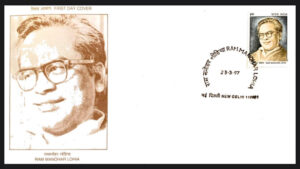
At the turn of the nineteenth century, Germany was the cultural hub of Europe. Philosophers such as Kant, Hegel and Nietzsche had provided a strong intellectual influence to new students. At the same time, economic theories of Marx and Engels were shaping the German working class and politics. At this vibrant time, a young Indian, Ram Manohar Lohia, enrolled himself at the Berlin University. His supervisor was the well-known sociologist, Werner Sombart. Meanwhile, miles away, Mahatma Gandhi, was staging a protest against the ruling British. Like other commodities, salt, could not be manufactured by Indians. They had to buy it at a high cost from British merchants. Gandhi, along with a few companions, walked to the Arabian Sea town of Dandi and illegally harvested the mineral from the beach. Lohia made the economics of salt his doctoral thesis. He had been fascinated by Gandhi ever since his father, Hira Lal, had taken him to one of the meetings where Gandhi was presenting.
Lohia’s exposure to European socialism and Marxism affected him. He believed that the cause of India’s stagnation was British imperialism. Exploiting Indian people created a stronger hold for British capitalism. While in Europe, Lohia attended a League of Nations meeting in Geneva. India was represented by the Maharaja of Bikaner, a supporter of the British. Britain’s intent was to influence more votes against the possibility of a future war. The Maharaja voted in Britain’s favour despite India not being an independent country. Lohia protested from the visitor’s gallery but was shut down. He began writing in newspapers and magazines and assembled other nationalist Indians in Europe under the Association of European Indians club.
Secondary Cadre at Work
The Civil Disobedience Movement was in full swing when Lohia returned to India. Sitting on the floor of Nasik Central Jail, several jailed congressmen, including Jayaprakash Narayan, decided to form the Congress Socialist Party. This ideology suited Lohia and he joined the party. As the editor of the weekly, Congress Socialist, he published articles promoting civil liberties and feasibility of a socialist India.
At the onset of the Second World War, Lohia urged Indians to boycott all government institutions. He got arrested but was released the next day as the British feared a youth uprising in the country.
Quit India movement in 1942 saw prominent leaders jailed. Lohia worked clandestinely during this period. Several posters, pamphlets and bulletins crying “Do or Die” got circulated in major cities. Lohia got them printed secretly and distributed with the help of supporters. A radio station, Congress Radio, broadcast messages on swaraj to its listeners. The location of the ratio station changed daily to avoid detection by police. Usha Mehta was one of the founders of this station who daily announced, “This is the Congress Radio calling from somewhere in India.” One of the voices belonged to Lohia. Eventually, their operation was detected and several perpetrators were sent to jail. Disguised under a different name, Lohia escaped to Calcutta to promote the revolution. He got arrested in Bombay in 1944 and was sent to the notorious prison in Lahore.
Tortured at the Lahore prison, Lohia’s health deteriorated. Several nights an iron rod kept knocking against a table next to his bed to prevent him from sleeping. A slight doze would attract twisting of his head or pulling of his handcuffs. His handcuffs, of different weights and sizes were changed daily to cause him inconvenience. He would be made to listen to a single word repeatedly for hours. However, Lohia’s spirit survived.
On Caste, Language and Economics
In independent India, Lohia preached the two principles that had influenced him, socialism and Gandhianism. He believed that capitalism and imperialism go together. European powers had exploited their colonies in Asia and Africa to extend their economic and political power. A shift to communism was not desirable either. Communism only breaks the ownership of the means of production from private to public domain. Communism was only a continuation of capitalism, when the latter fails. His Gandhian philosophy suggested that power and authority be dispersed and decentralized among villages, districts, provinces and centre. This kind of socialism alone would ensure equality and prosperity.
Lohia wrote on the caste system. There is a caste-wise determination of skills. Certain skills such as trade, craft, husbandry or administration are hereditary. This results in some skills getting downgraded and others becoming superior. The latter, although fewer in number, provided the nation’s leadership. To maintain their dominance, they create a sense of inferiority among those they govern. The superior skill caste, the elite, have speech, dress, manner and living that inferior skill caste cannot emulate. He thought that the ruling party and its leaders had deliberately distanced themselves from the people of India. They were brown in colour but white in their language, customs and manner.
His anti-elitist views also reflected when he talked about banishing English from India. To him language was a carrier of culture, customs, ethos and lifestyle. This was a tool for communication between government and people. The English educated population was a tiny minority. The English language created a distance between those that understood it i.e. the affluent section of society and those that didn’t. He went as far as to suggest that an Indian scholar had to learn English language and was thus overburdened and unable to reach the depth of a subject.
He died of a medical complication at the Willingdon Hospital in Delhi, which got renamed later as Dr. Ram Manohar Lohia Hospital to honour him.