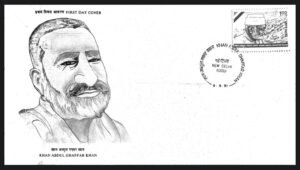
The rugged Khyber Pass is a historical gateway between Central and South Asia. It is part of the North-West Frontier Province (NWFP), which is immortalized by Khan Abdul Ghaffar Khan. At six feet three inches, ‘Frontier Gandhi’ walked the hilly terrain spreading Mahatma Gandhi’s gospel of satyagraha, non-violent resistance. Of his long life of 97 years, almost 35 were spent in British and Pakistani prisons. Out of prison, he once remarked, “With love you can persuade a Pathan to go to hell, but by force you cannot take him even to heaven.”
The NWFP voted overwhelmingly to be part of Pakistan when India was split into two countries in 1947. Rejecting the referendum, Ghaffar Khan clamoured for a separate Pathan nation called Pashtunistan. His followers were dubbed ‘Red Shirts’ (Khudayi Khidmatgars) because of their garments dyed from red bricks. Ghaffar Khan remained controversial till his death. In his nineties and in a wheelchair, the frail Ghaffar Khan flew to Karachi to meet a Sindhi leader. However, the Pakistani government had imposed a ban to prevent the meeting. At the Karachi airport, hundreds of police with machine guns in hand encountered the man in wheel chair and asked him to return to Peshawar, the capital of NWFP.
When illness gripped Ghaffar Khan, he refused medical treatment in Pakistan. The Indian government sent a plane to bring him to India, where he was also awarded the Bharat Ratna, the highest civilian decoration in 1987.
To read more about Khan Abdul Ghaffar Khan and his Khudayi Khidmatgars, please refer to page 356 of the book.
Sources: “The Best of TIME” in The Herald (Melbourne), January 23, 1954; “Obituary ‘Frontier Gandhi’ at 97” in The Canberra Times, January 21, 1988